Class 9: AI Remix Jam. "Argue with it, until you get something you like."
CreativeAI Academy
The class in brief
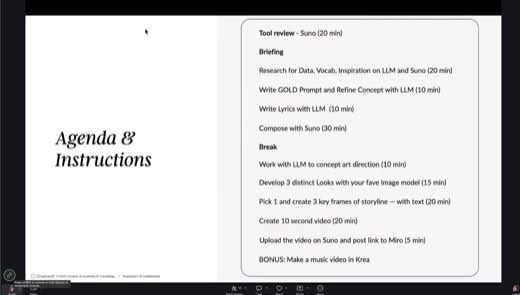
Tony ran the room through a full music-video pipeline in one sitting. Concept it with an LLM, write and compose a song in Suno, then create a cover, keyframes, and a short video. The finished link was posted to Miro before the night ended.
The GOLD prompt and the "Wrestle With AI for Concepting" 7 principles carried the writing. Suno's own mechanics carried the sound. After this page you can write a GOLD prompt yourself instead of asking AI for one, and direct lyrics with bracket and parenthesis cues. You can also argue with a first draft until it's actually yours.
The pipeline, previewed
Why this matters · 6:20 PM
Study the top tracks before you write a single lyric.
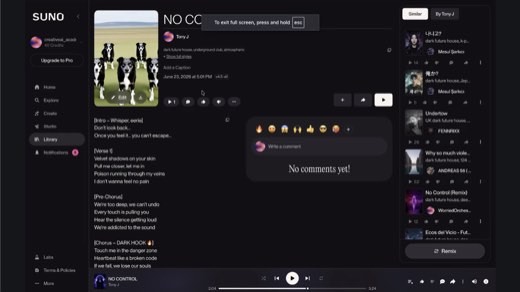
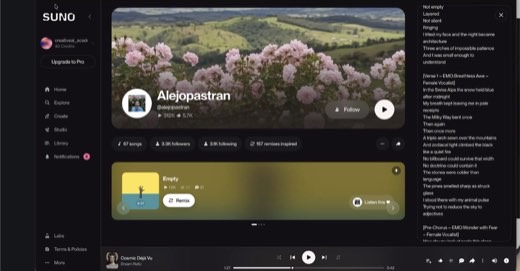
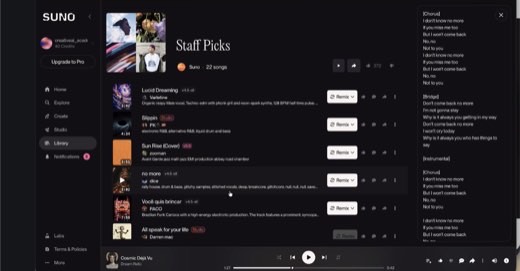
Tony's brief for the night: research and wrestle with an idea using an LLM before writing anything . Study Suno's own top tracks first to learn the vocabulary, the same tool-review-before-generating habit the room had already built with images .
The chain ran the whole night, in ten stages:
- Research and vocabulary.
- A GOLD prompt.
- Lyrics with an LLM.
- Composing in Suno.
- Break.
- Art direction.
- Three looks.
- Keyframes.
- A short video.
- Post the link to Miro.
The framework · 6:33 PM
Write your own GOLD prompt
Tony's instruction was specific: write the prompt yourself, don't ask the AI to write your song for you. GOLD structures that first move into four parts.
Goalwhat you're actually after
"My goal is to write a song," stated plainly, before anything else gets specified.
Outputideas, not a finished piece
"The output is ideas for the song, not necessarily the song itself." Stage it deliberately rather than asking for a finished draft in one shot.
Limitationsstay in conversation
Limit the AI to a back-and-forth rather than a single output; nothing gets locked in on the first pass.
Datatopic, artists, styles
The concrete material: what the song's about, and the music you actually like, fed in as the starting vocabulary.
"My goal is to write a song. The output is ideas for the song, not necessarily the song itself."
Tony, modeling a GOLD prompt live for the room
The exercise · 6:57 PM
Wrestle with AI for concepting
How to actually argue with an LLM until a lyric is worth keeping.
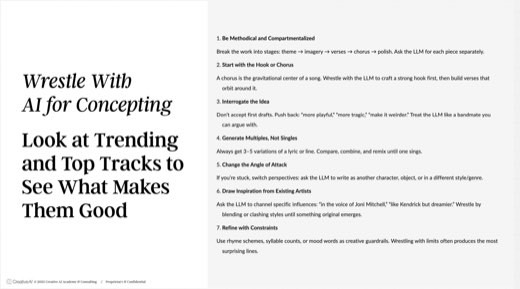
The core slide of the night presented :
- Be methodical: stage it theme to imagery to verses to chorus to polish.
- Start with the hook, the song's gravitational center.
- Interrogate every idea instead of accepting the first draft.
- Generate 3 to 5 variations, not one.
- Change the angle of attack when stuck, by trying a new character or a new genre.
- Draw on named artists, "in the voice of X."
- Refine with constraints: rhyme, syllables, mood words.
"Try to argue with it until you get to something you like."
The board that catches it all
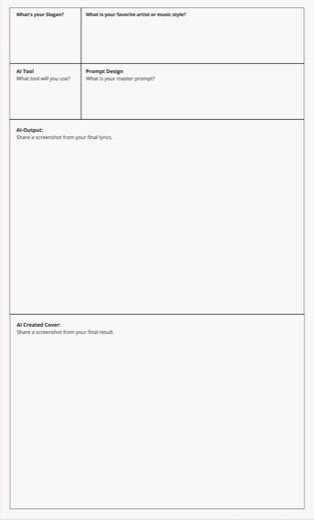
Every deliverable had a home before anyone started, six cells on a shared classwork board .
- The first cell was slogan.
- The second cell was favorite artist or style.
- The third cell was the AI tool used.
- The fourth cell was the master prompt.
- The fifth cell was the AI-output lyrics.
- The sixth cell was the finished cover.
Don't settle for one
The room's live coaching, repeated during the image-direction stretch: don't take the first result, keep pushing until it's actually right, then generate the set you need from there. The interrogation principle, applied in real time.
From Suno to video
The craft · 7:01 PM onward
One song, built in Suno, then carried into a short video.
- Suno runs on two fields, Lyrics and Styles, the second a short list of non-conflicting tags. The room's rule of thumb was to ask an LLM to boil a style down to five essentials first.
- Remix > Reuse Prompt borrows a track's own prompt to study.
- A free voice toggle covers male and female, with "baritone" or "chest voice" for a lower register.
The video half chains two more tools onto the song. Generate a start frame and an end frame separately, then hand them to Adobe Firefly (firefly.adobe.com, Video > Generate Video) or to Krea (LTX and Veo 3.1 Light).
Both take the same start-plus-end-frame input and return a short clip, roughly 8 seconds long. The finished clip uploads back into Suno, replacing the track's cover image, and loops.
Methods and prompts
Five methods to take with you
Write your own GOLD prompt
Goal, Output, Limitations, Data, written by you before AI touches the idea. The discipline is in staging the output as ideas, not a finished piece, on the first pass.
Working prompt
My goal is to [what you actually want, e.g. write a song about X]. The output I want right now is ideas, not a finished piece. Stay in conversation with me and don't lock anything in yet.
My limitations: ask me one question at a time. My data: [topic, artists or styles I like]. Start by asking me what you're missing.
You will know it worked whenit opens by asking you one question at a time about what's missing. It doesn't hand back a finished piece on the first pass.
Argue with the first draft
Don't accept the first version. Judge it yourself first, then have the model check your read, and push the direction you actually chose.
Working prompt
Here are the first ideas you gave me: [paste]. I'll say first what's wrong with each one and why, then you check me: did I miss a reason to reject one, or a reason to keep one I cut? Then give me a version that's more [tragic / playful / specific], whichever direction I chose.
You will know it worked whenit points out a specific idea you cut or kept that your own reasoning missed. Then it delivers a version pushed toward the direction you named.
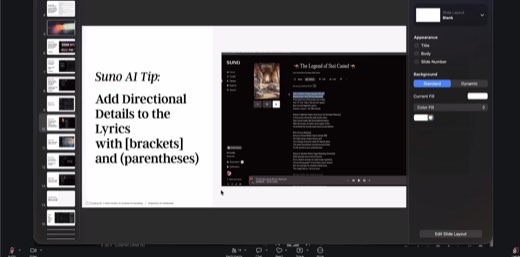
Direct the lyrics with brackets and parentheses
Structure tags in [brackets], delivery cues in (parentheses). Suno reads both as instructions, not lyrics, so it's the difference between a flat take and a directed one.
Working prompt
Write lyrics for [song idea], and mark every section with [brackets] for structure ([Verse], [Chorus], [Instrumental]) and (parentheses) for delivery cues like (whispered) or (building). I'll paste this straight into Suno.
You will know it worked whenevery section carries a bracketed structure tag and every delivery cue sits in parentheses, ready to paste straight into a music tool without reformatting.
Refine with constraints
Ask for several versions before picking one, then push the winner against real constraints instead of accepting it as-is.
Working prompt
Give me 3 to 5 versions of this [verse / hook / line]. Then I'll pick a direction, and you refine it against these constraints: [rhyme scheme, syllable count, mood words].
You will know it worked whenthe refined version actually fits the rhyme scheme, syllable count, and mood words you named. It should not be just a reworded version of the one you picked.
Boil the style down to 5 tags
Suno rewards a short, non-conflicting tag list over a paragraph of description. Let the LLM do the compression.
Working prompt
Here's what I want this track to sound like: [describe freely, genres, artists, mood]. Boil it down to 5 essential style tags, comma-separated, non-conflicting, ready to paste into Suno's Styles field.
You will know it worked whenyou get exactly five comma-separated tags that don't contradict each other, ready to paste into a music tool's style field.
The shelf
Tools and references
Tools that night
- Suno (suno.com), Suno Labs Genre Wheel for reverse style discovery
- Nano Banana (Gemini image model), a cover-art option
- Adobe Firefly (firefly.adobe.com), video from two frames
- Krea (LTX / Veo 3.1 Light), start-plus-end-frame video
- ChatGPT, Gemini, or Claude for the GOLD prompt and lyrics
Named in the room
- GOLD: Goal, Output, Limitations, Data, the night's prompt skeleton
- Wrestle With AI for Concepting, the 7-principle songwriting framework
- The Miro board, where every finished song link and cover landed
Every frame from this class
7 captures, in order. Click any one to see it full size.