Class 10: AI-Enabled Ideation. "It doesn't matter what the model learned from, the interesting thing still comes from you."

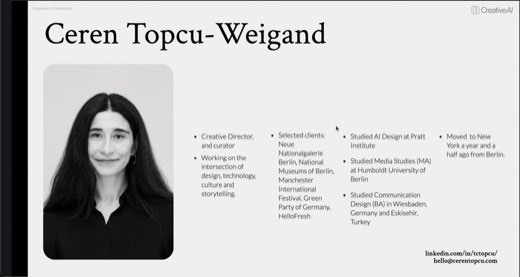
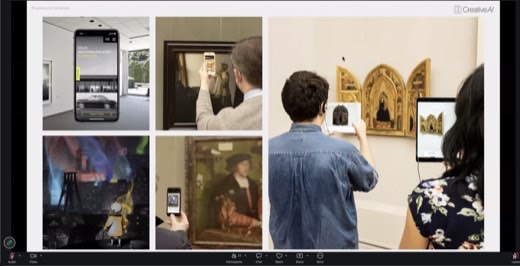
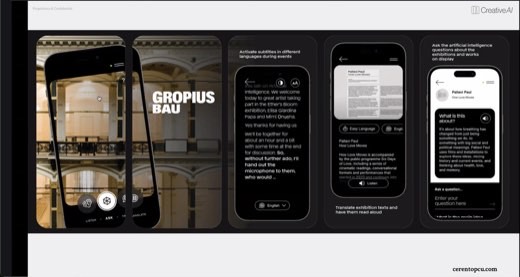
Built the Gropius Bau ChatGPT visitor guide (2022)

Educator, Creative AI Academy
The class in brief
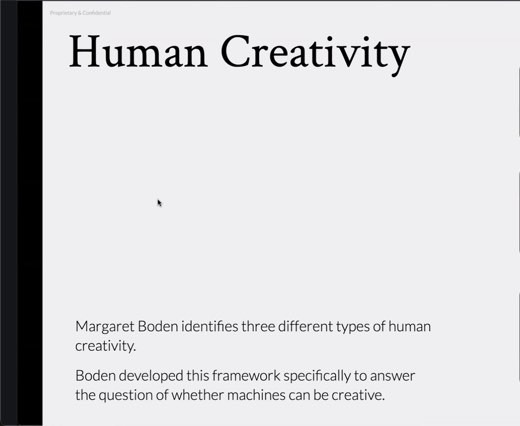
Ceren opened with Margaret Boden's three types of creativity. She also made the case for a personal archive as "ground zero," the source you check AI output against.
Sydney closed with her own research method: interview-style prompting, forced connections, and a conversational path to a portable writing-style guide. After this page you can run the Interviewer and Interpreter modes on a real brief and force two unrelated domains into a new idea. You can also check any AI output against your own archive instead of its enthusiasm.
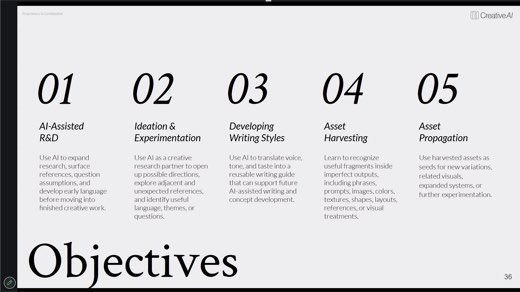
The five objectives
Why this matters · 6:13 PM
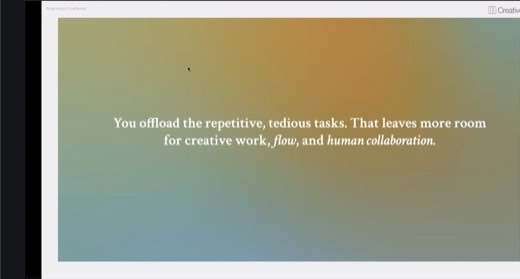
You define good. The machine generates toward it. You decide when it's done.
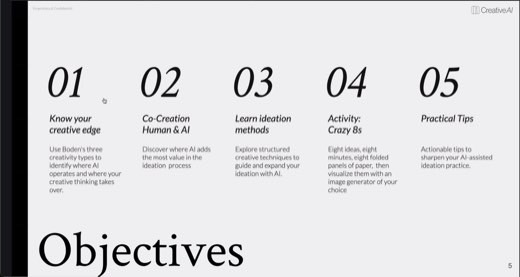
Ceren opened on five objectives for the night :
- Know your creative edge.
- Co-creation between human and AI.
- Ideation methods.
- A Crazy 8s activity.
- Practical tips.
The frame underneath all five is the same co-creation slide line that gives this page its hero quote. You bring the intent, the machine generates the range, and judgment stays yours.
"AI is sycophantic and will back your worst ideas, so you need an external source you trust as ground zero."
Sydney, on why a personal archive matters
The framework · 6:33 PM
Boden's three types of creativity
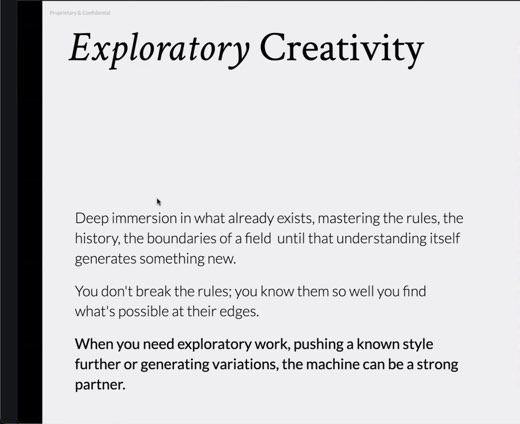
Exploratorythe most common type, and AI's strongest match
Deep immersion in a known style until you find what's possible at its edges. Example: Monet painted the same pond for thirty years, pushing it toward abstraction. . AI is pattern recognition, which makes it a strong partner for pushing a known style and generating variations.
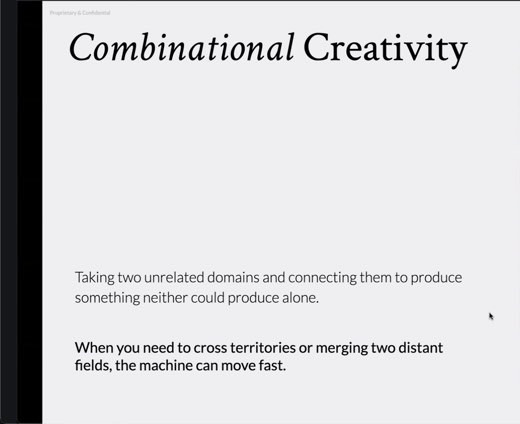
Combinationalmerge two unrelated domains
Connect fields that have never met to make something neither could alone. Example: the 2007 iPhone combined an iPod, a phone, and a web device. . AI moves fast across distant fields, which is why Forced Connections works.
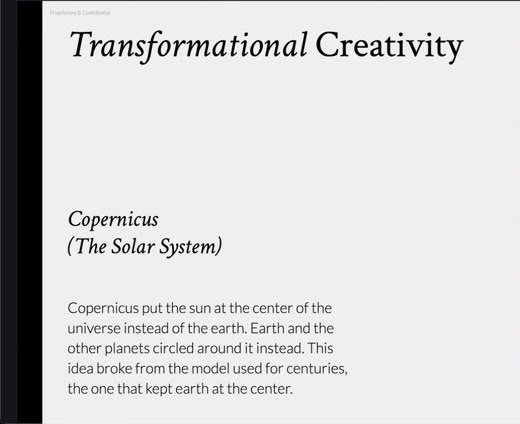
Transformationalrarest, and still an open question for AI
Break the rules everyone thought were fixed and start over with new ones. Example: Copernicus put the sun at the center. . AI can help humans find transformational ideas; whether it can originate a paradigm shift alone stayed an open question in the room.
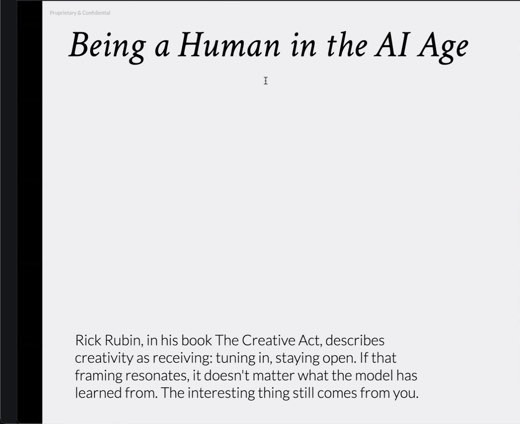
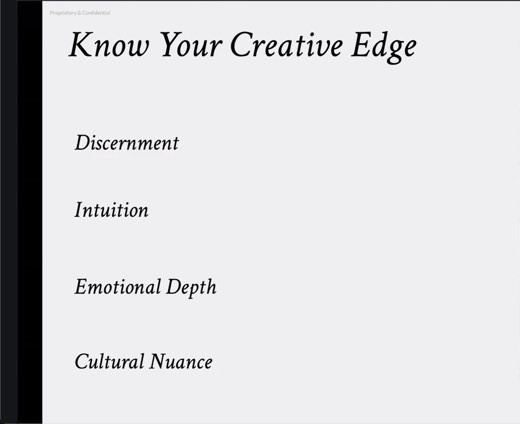
Ceren followed the framework with the Rick Rubin line that anchors this page . She then named the four things AI still can't do for you .
Co-creation and the personal archive
The idea · 6:40 PM
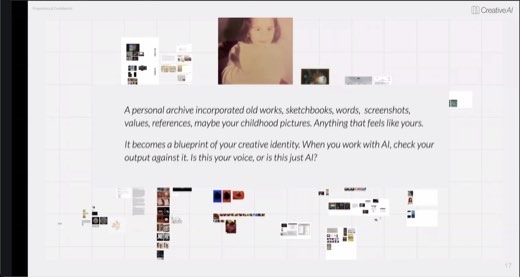
Your personal archive is the blueprint of your creative identity, and the thing you check AI against.
Your personal archive can include old photos, sketchbooks, writing, values, saved references, even saved AI outputs . This is Ceren's answer to a model that flatters everything you show it.
Sydney's co-creation loop adds the other half . You bring the creative intent and set the vision, the machine generates many variations, and you decide when it's done.
The exercise · 6:51 PM
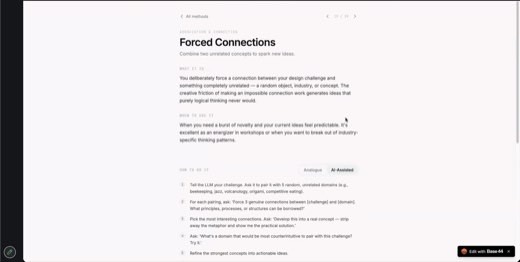
Running Forced Connections live on the Ideation Atlas
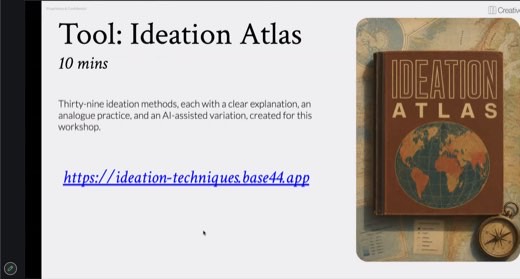
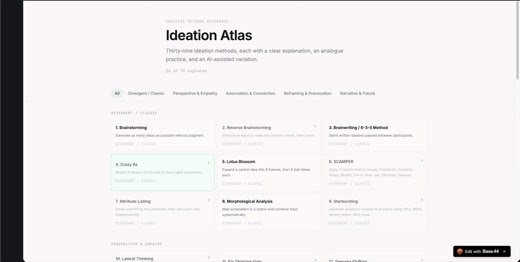
39 ideation methods, each with an AI-assisted variation.
Ceren built the Ideation Atlas on Base44, a no-code app builder . It gives each of its 39 methods an explanation, an analogue practice, and an AI-assisted variation, sorted into five categories.
- Divergent/Classic is the first category.
- Perspective & Empathy is the second category.
- Association & Connection is the third category.
- Reframing & Provocation is the fourth category.
- Narrative & Future is the fifth category.
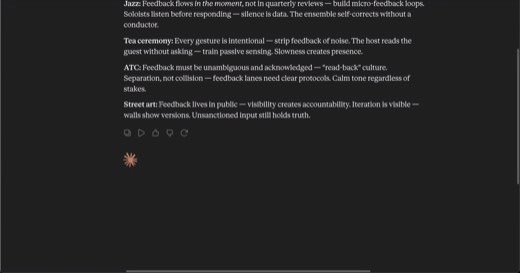
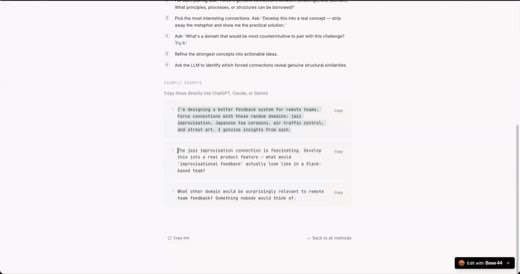
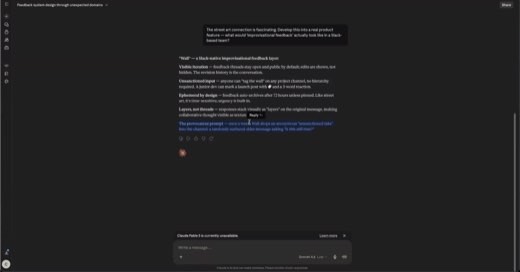
The room worked Forced Connections.
- Name your challenge.
- Add a few genuinely distant domains.
- Ask for a handful of real insights from each.
- Pick the collision worth pursuing.
Cap the output. About five sentences per domain, so it doesn't flood you.
Stay vague to reach surprising places
Tony's warning, repeated through the room: if you let on that you're honing toward one idea, the model "chases you and paints you into that corner."
The method works because the domains stay unrelated on purpose.
Branching a thread
Edit an earlier turn, or use the three-dots menu and "Branch in new chat," to fork a research direction while keeping the original intact. One classmate reached Pauline Oliveros's Deep Listening this way, starting from a science-center exhibit brief.
The power is in the prompt
Sydney's own admission: she wrote her research-collaborator persona, then used an LLM to troubleshoot and harden it, so it pushes back instead of turning into a generic idea machine. Writing the prompt is itself part of the craft.
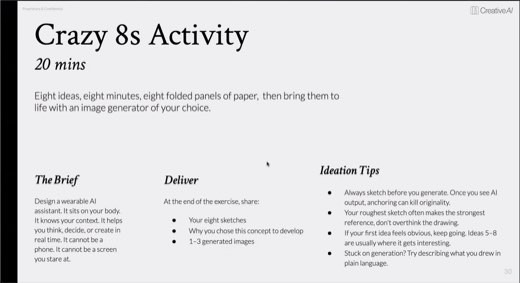
The Crazy 8s activity
The activity · 7:14 PM
Eight ideas. Eight minutes. Eight panels.
Crazy 8s closed the ideation block : a brief, a strict clock, and eight quick panels, described in plain language before any image generator touches it. The eight-minute sketch phase sits inside a twenty-minute window. Ceren's 5-tips slide, which followed the break, reads as the instruction manual for everything the room had just done .
"Describe your rough sketch in plain language, then let the image generator work from that."
Ceren, on the Crazy 8s hand-off to AI
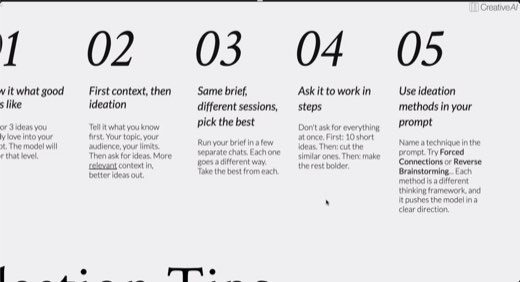
Methods and prompts
Five methods to take with you
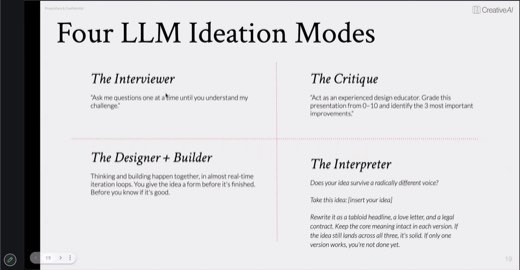
Interviewer mode
Before you generate anything, let the model find your real problem. It asks one question at a time until the actual challenge surfaces, instead of you guessing at a brief.
Working prompt
Ask me questions one at a time until you understand my challenge. Don't offer solutions yet, just keep asking until the real problem is clear, then summarize it back to me before we go any further.
You will know it worked whenit asks one question at a time and holds off on offering solutions until it summarizes the problem back to you.
Critique mode
Grade your own idea before you present it, using an outside voice instead of your own comfort with it. Judge it yourself first: the model's job is to check your grade, not set it.
Working prompt
Here's my concept: [paste]. I'll grade it first: my score out of 10 is [your number], and the weakest part is [your answer]. Now act as an experienced design educator, grade it 0 to 10 yourself, and name the 3 most important improvements. Tell me where my own score was wrong.
You will know it worked whenit gives its own number apart from yours and names three specific improvements, then tells you plainly where your own score missed something.
Interpreter stress test
Rewrite the idea in three unrelated voices and see what survives. Decide for yourself which retellings still hold the core meaning before asking the model to check your read.
Working prompt
Rewrite this idea [paste] as a tabloid headline, a love letter, and a legal contract, keeping the core meaning intact in all three. My read: it survives in [name which ones, for you]. Now you check me: does the core idea actually hold in the ones I picked, and where does it break in the others?
You will know it worked whenit checks your guess about which retellings still hold the core meaning against what actually survived in each of the three versions.
Forced Connections
Ceren's Ideation Atlas method, run in a plain chat. Give the challenge, add distant domains on purpose, cap the output so it doesn't flood you.
Working prompt
Here's my challenge: [paste]. Force it through these four unrelated domains: [name four, deliberately distant]. For each one, give me 2 to 3 genuine insights, about 5 sentences total per domain. Don't soften the domains to fit the challenge, let the friction do the work.
You will know it worked wheneach of the four domains produces insights that actually come from that domain's own logic, not the same idea restated four times.
Build your writing-style guide
Sydney's second method: edit a sample paragraph conversationally, then have the model analyze the whole exchange and write a reusable style guide you save and upload wherever you write.
Working prompt
Write two paragraphs on [any subject]. I'm going to edit them conversationally: for each change I'll tell you why I'm making it and the tone I actually want. Once we're done, analyze the whole exchange and write me a reusable style guide, as rules with examples, that I can save and hand to any tool.
You will know it worked whenthe style guide it writes back names specific rules with examples pulled from your actual edits, not generic writing advice.
The close · 7:43 to 8:03 PM
AI opens the research space wide. You keep judgment and voice.
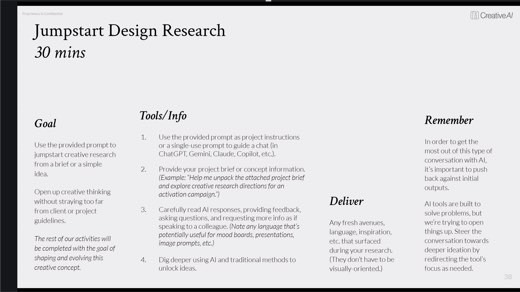
Sydney closed the night with her own five-part method , then handed the room a 30-minute activity to run it live .
- Paste her creative-research-collaborator prompt into a new chat.
- Give it a brief.
- Let it question you before it offers domains and real references, never finished ideas.
- Push back on its first answers.
- Save the fragments that work and grow them into later projects.
Ceren and Sydney closed together on contact info before the room broke .
Try this prompt
Quiz me on Boden's three creativity types and the four LLM ideation modes. Then give me a small challenge and make me run it through Interviewer mode and Forced Connections.
You will know it worked whenit quizzes you on Boden's three creativity types and the four ideation modes first. Then it makes you run a small challenge through Interviewer mode and Forced Connections.
The shelf
Tools and references
Tools that night
- Ideation Atlas, ideation-techniques.base44.app, 39 methods built by Ceren on Base44
- ChatGPT and Claude, used live for Forced Connections and the research-collaborator prompt
- MCP (Model Context Protocol) explained as a concept, example given: Canva connected to ChatGPT
Named in the room
- Rick Rubin, The Creative Act · Margaret Boden, creativity types
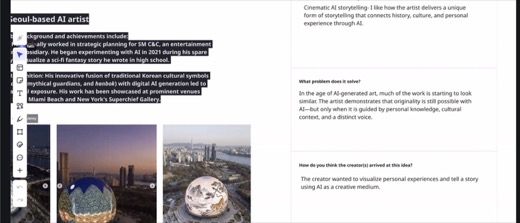
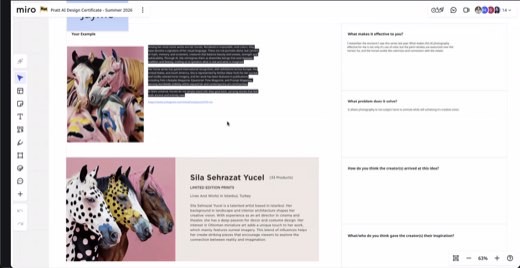
- Sila Sehrazat Yücel and Keepkwan, AI artists referenced for the creative-edge discussion
- Pauline Oliveros, Deep Listening · cerentopcu.com, hello@cerentopcu.com
Every frame from this class
26 captures, in order. Click any one to see it full size.