Class 20: Brief Mining. "What is the tension the brief is too polite to say?"

The class in brief
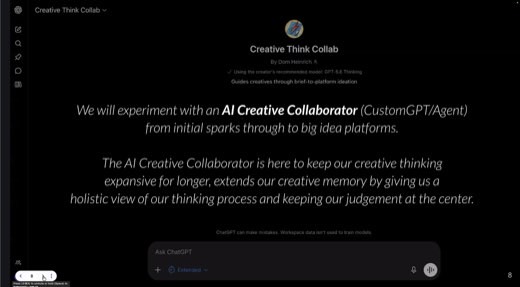
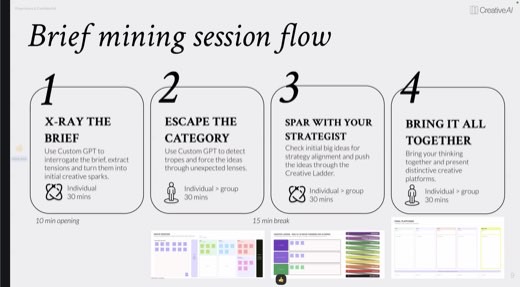
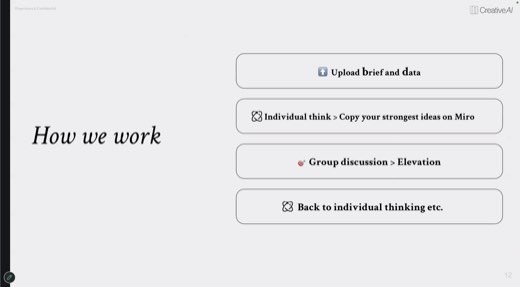
Angella Tapé returned with the Creative Collaborator, a custom GPT built by the teaching team to walk a brief through five stages.
- X-ray the brief.
- Escape the category.
- Spar with your rebel strategist.
- Bring it all together.
- Build a unique brand voice.
The class ran the capstone brief through it live, individually and then as groups on Miro. After this page you can x-ray any brief for the tension it avoids saying, score ideas against the creative ladder, and steal Angella's design constraints for your own GPT builds.
Own the conversation
Why this matters · 6:15 PM
The tool asks the questions. You still own the conversation.
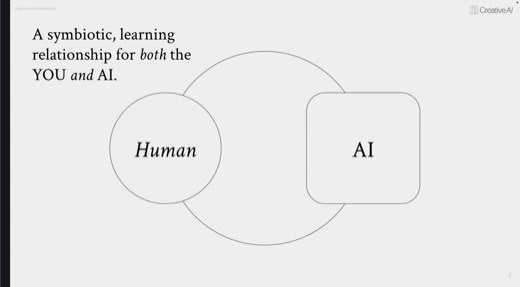
The Creative Collaborator was built by Angella, Tony, Sydney Seifert-Gram, and Dominik out of their human-AI-relationship research. The last version overpowered users with questions, so she rebuilt it with five constraints.
- Two questions per section maximum.
- Approval required before any stage advances.
- Questions modeled on what creative directors actually ask.
- Outputs pre-formatted as tables.
- The creative ladder uploaded as knowledge .
Thinking is not linear, and the tool is built to follow yours, not replace it .
The framework · 6:26 PM
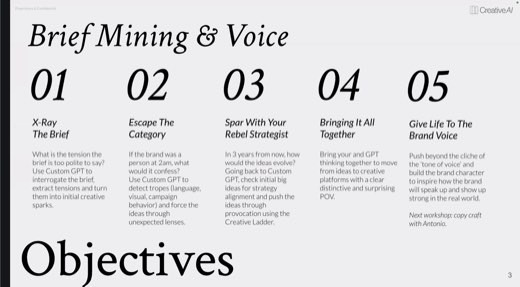
The five stages of brief mining
X-ray the brieffind the tension it avoids stating
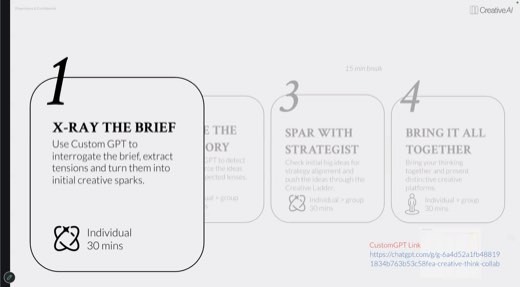
"What is the tension that the brief is too polite to say?" Output: five to seven spark ideas as a table, each carrying the insight, the enemy, the role of the brand, and why it matters.
Escape the categorybreak the conventions
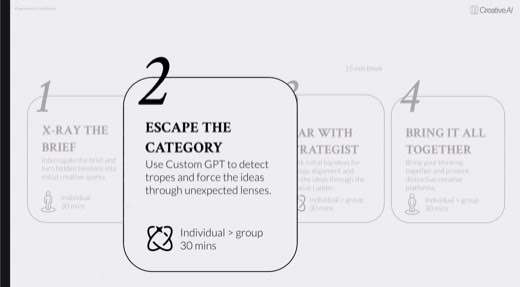
"If the brand was a person at 2 AM, what would it confess?" Ideas get forced through unrelated lenses: art, architecture, music, cosmetics, choreography, medical devices.
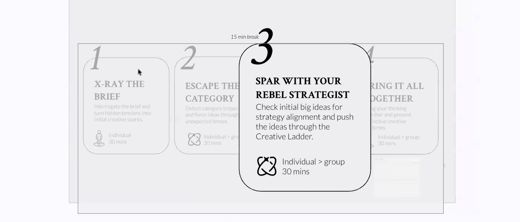
Spar with your rebel strategistscore against the ladder
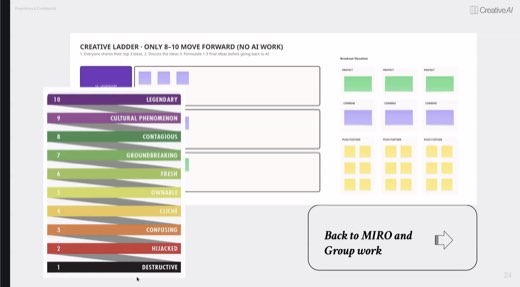
Every idea lands somewhere on the creative ladder, 1 to 10. The target is the zone of creative genius: contagious, cultural phenomenon, legendary. Anything below gets killed.
Bring it all togetherthe idea, stated
Idea title plus description, in your chosen construct. Every choice earns a rationale.
Build a unique brand voicebonus stage, not run in class
Give the idea a voice of its own, inspired by the Liquid Death example.
The exercise · 6:32 PM onward
Mining the capstone brief live
Run the Coca-Cola holiday brief through all four stages.
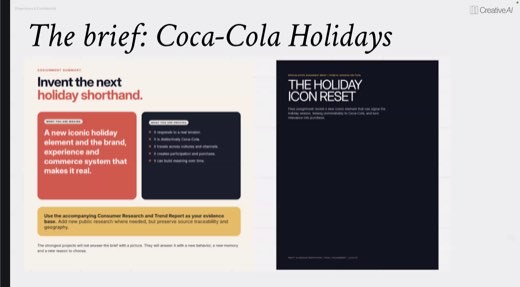
The night's material was the real final assignment: invent the next holiday shorthand for Coca-Cola . Each stage ran thirty minutes: individual work in the GPT first, then group elevation on Miro.
Nothing was due that night. "You're building to your final assignment."
Every group converged on the same ideas
The room's reaction, a shared sigh and a pause, showed everyone had already noticed the pattern, before anyone said it aloud: the share-outs kept producing the same concepts in different wrappers. The cause got named in the room: same source material, same model, same guardrails.
It is the course's multi-order lesson demonstrated live, and the reason the next class's winning concept came from human forced connections instead.
The archive gap
One wish from the room: a collaborator with a creative archive, so it can say "someone already did this." Angella's honest answer: no archive-aware system that reliably detects prior work exists yet, because AI presents everything as if it has never been done.
The current workaround, credited to Sydney's Class 4 session on prompt libraries: upload a board of your own work as knowledge and make the tool study it before continuing.
The fight for something physical
Every generated concept was a feeling. The push that mattered was for something tangible, "recognizable, that someone will still remember what it looked like five minutes later." The gap between a feeling and an object turned out to be the real creative problem of the night.
Escape the category
The craft · 7:25 PM
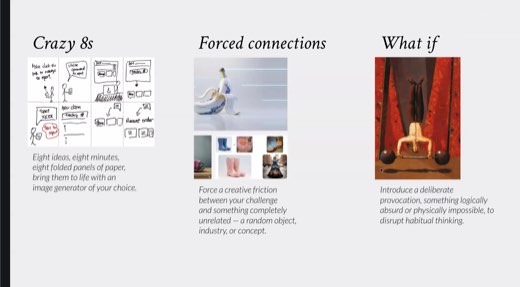
Three ways to force an idea somewhere new.
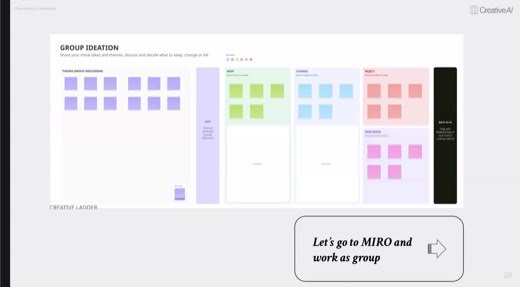
After the break, stage 2 got its own toolkit : Crazy 8s (eight sketch ideas in eight minutes), forced connections (collide the idea with an unrelated object), and what-if provocations. Then back to the group board: keep, change, reject, new ideas, and a black column for what goes back to the AI .
The judgment · 7:27 PM
Only 8, 9, and 10 move forward. No AI in the room for this part.
The creative ladder runs from destructive at 1 to legendary at 10, and the elevation round is deliberately human: share your top three, discuss, protect, combine, push further . The finals template demands a rationale for every choice: name, description, why it works .
"Now we're getting into the meat of what we need AI to do, not what it can do."
Angella, responding to the room's wishlist
Methods and prompts
Five methods to take with you
X-ray the brief
Interrogate any brief for the tension it avoids stating, before a single idea gets generated. The output format does half the work: insight, enemy, role of the brand, why it matters.
Working prompt
Here is my brief: [paste]. X-ray it: what is the tension this brief is too polite to say? Give me 5 to 7 spark ideas as a table, each with the insight, the enemy, the role of the brand, and why it matters.
X-ray a brief of your own →You will know it worked whenthe table lists five to seven ideas, each with its own insight, enemy, and role for the brand, not one idea repeated with different words.
The 2 AM confession
Escape the category by forcing the brand and the idea through frames the category never uses. The confession question breaks the polite surface fastest.
Working prompt
If this brand was a person at 2 AM, what would it confess? Then take my strongest idea and force it through five unrelated lenses: art, architecture, music, choreography, medical devices. Show me what survives the trip.
You will know it worked whenwhat survives the five lenses looks genuinely changed by at least one of them, not the same idea restated in new dress.
Spar with your rebel strategist
Use AI to pressure-test every idea against a ladder whose top three rungs are contagious, cultural phenomenon, legendary. That scoring is optional prep. The actual kill decision happens after, in a human-only elevation round with no AI in the room.
Working prompt
Act as my rebel strategist. Score each idea above on a 1 to 10 creative ladder where 8 is contagious, 9 is a cultural phenomenon, and 10 is legendary, and tell me why. Do not kill anything yourself: bring these scores to my group so we make the final call together, with no AI in the room.
You will know it worked whenmost of the ideas actually get killed for scoring below eight, and the survivors get a specific reason, not just a passing grade.
Make it study your archive
AI presents every idea as if it has never been done. The current fix: upload your own body of work as knowledge and make the tool study it before ideating, so "someone already did this" becomes possible.
Working prompt
Before we ideate: here is a collection of my past work [upload]. Study it. Tell me the patterns you see. When we generate ideas, flag anything that repeats what is already in this uploaded work.
You will know it worked whenthe new ideas get flagged specifically when they repeat something in your own uploaded work. This checks your archive only, not the whole category; a category-wide check needs a separate, dated corpus of other people's work.
Stage-gate your own GPT
Angella's design constraints, portable to any assistant you build: capped questions, approval gates, questions modeled on what creative directors actually ask, pre-formatted outputs, and reference material uploaded as knowledge. The user owns the pace.
Working prompt
You work in stages. Ask me at most two questions per stage. Deliver every output as a table I can copy. Never advance to the next stage until I approve. I own the pace of this conversation.
You will know it worked whenit asks no more than two questions per stage and stops for your approval before moving to the next one.
Where it broke
Where it broke · all night
The tool fought the brief it was mining
The problem: the Collaborator is prompted to refuse icons, caricatures, and symbols, while the capstone brief asks for exactly that, a new holiday icon. The fix in the room: direct pushback, "you are not the client, you do not determine what the final is," until the tool conceded.
The takeaway sent to the teaching team: a guardrail written for one assignment can quietly fight the next one.
The other failure was subtler: convergence. Same brief, same model, same guardrails, and every group's output rhymed. The tool did not break; it worked identically for everyone, which is its own kind of breaking.
Try this prompt
Quiz me on Angella's five brief-mining stages and the creative ladder. Then give me a practice brief and grade my x-ray of it.
You will know it worked whenit quizzes you on the five brief-mining stages and the creative ladder first, then grades your own x-ray of a practice brief.
The shelf
Tools and references
Tools that night
- The Creative Collaborator custom GPT ("Creative Think Collab"), built by the teaching team
- Miro group boards: themes, keep/change/reject, elevation, final platforms
- The creative ladder, uploaded to the GPT as knowledge
Named in the room
- Liquid Death, the brand-voice inspiration for stage 5
- The Coca-Cola Holiday Icon Reset brief, the night's working material
- Sydney's archive advice, the current answer to the originality problem
Every frame from this class
13 captures, in order. Click any one to see it full size.